
G-SYNC 101: Hidden Benefits of High Refresh Rate G-SYNC


Bonus Points

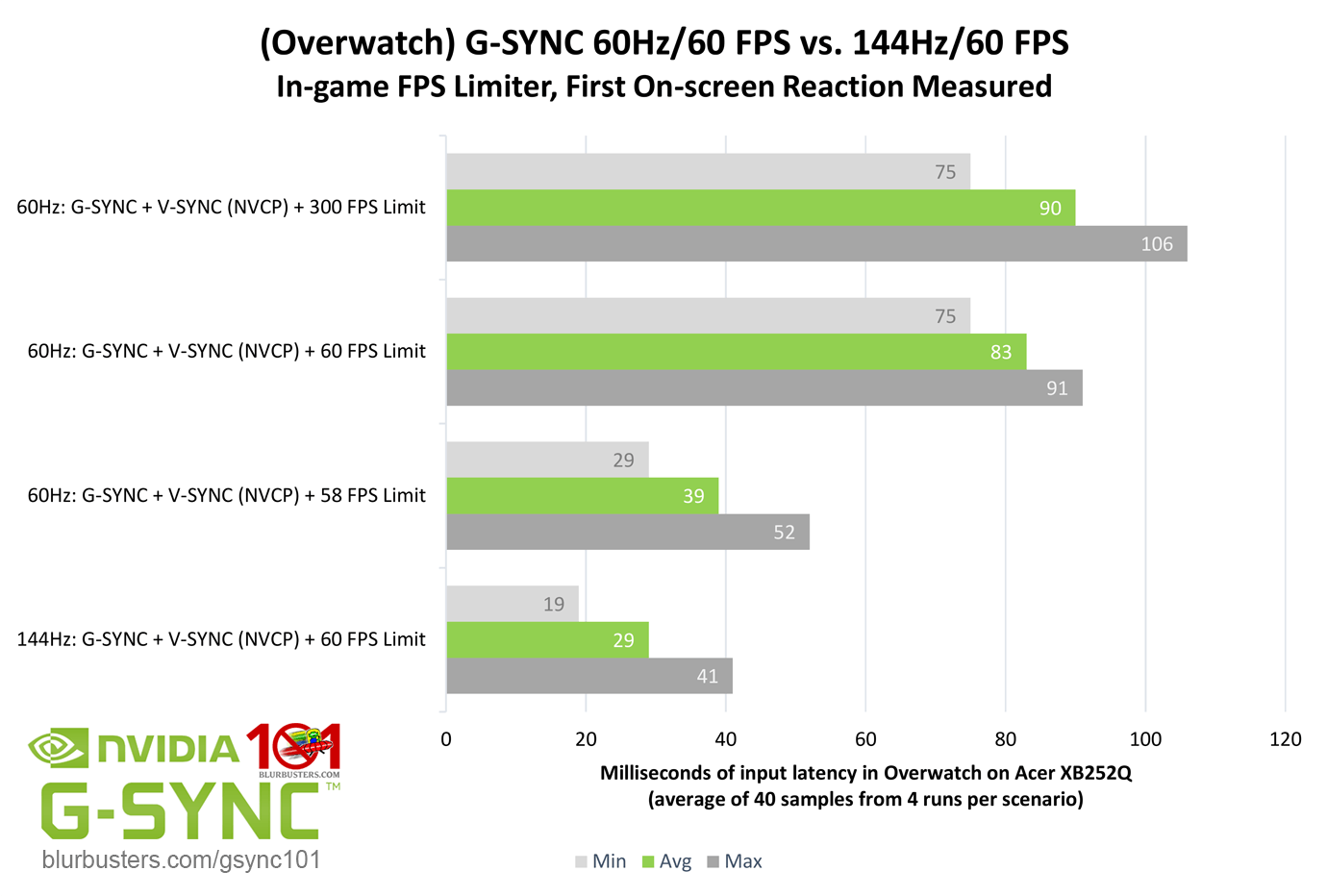
Often overlooked is G-SYNC’s ability to adjust the refresh rate to lower fixed framerates. This can be particularly useful for games hard-locked to 60 FPS, and has potential in emulators to replicate unique signals such as the 60.1Hz of NES games, which would otherwise be impossible to reproduce. And due to the scanout speed increase at 100Hz+ refresh rates, an input lag reduction can be had as well…
Blur Buster's G-SYNC 101: Input Lag & Optimal Settings

The results show a considerable input lag reduction on a 144Hz G-SYNC display @60 FPS vs. a 60Hz G-SYNC display @58 FPS with first on-screen reactions measured (middle screen would show about half this reduction). And while each frame is still rendered in 16.6ms, and delivered in intervals of 60 per second on the higher refresh rate display, they are scanned in at a much faster 6.9ms per.



3755 Comments For “G-SYNC 101”

This site uses Akismet to reduce spam. Learn how your comment data is processed.

Sort by:   newest | oldest | most liked
Razvan Badaluta
Member
Razvan Badaluta

Hello!

Without a fps cap i am getting around 800 fps in fortnite creative but when i turn v sync on( even in the Nvidia apps) i am getting a limit at 438 or sometimes 425 ( i have the xg27aqdpg 500 Hz monitor) i want a fast frametime and fps as close as I can get to the monitor refresh rate but i do not want tearing. I tried playing around with Nvidia low latency but i did not notice any difference. All this happened with g sync on. I did something wrong? any tips?

Noidy
Member
Noidy

Hello!

Im getting lost in the sauce… I Have an AMD gpu with a freesync premium pro display (msi maq 1440p oled 240hz). I play mainly overwatch but I like to play with a tear free screen. So with -3 fps limit, Freesync + v-sync i only add 1 ms of delay compared to freesync/vsync off and fps unlimited?

wttrbb
Member
wttrbb

Hey man thanks for the detailed guide! I’m sorry if this is been mentioned anywhere I just couldn’t find it. What would your recommended settings for frame generation in games be? Is there anything to keep in mind when using that?
Kind regards

schustez
Member
schustez

does using reflex on + boost or ultra low latency always cap your fps below the max refresh rate of your monitor when you can sustain a higher fps or only when you are gpu bound?

higorhigorhigor
Member
higorhigorhigor

In my tests with the AMD RX 6750 XT, an LG 180hz IPS monitor, on both Linux and Windows 11, I noticed that when I cap the FPS at 60, for example, in scenarios that could deliver 160 uncapped, what happens is that my GPU significantly reduces its clock speeds, and this creates instability in frame production, causing the refresh rate to fluctuate widely.

On Linux, in LACT (a program for managing GPUs on Linux), I created a profile for the specific game and activated a performance level option that keeps the clock speeds higher. This completely solved the problem that occurs when I limit the FPS far below what my GPU can produce.

On Windows, I haven’t found a similar option to this, but I also haven’t looked much since I’m not using Windows a lot. I came here to comment, so that in case you weren’t aware of this, it might help other users who feel they have this VRR disengagement issue even when the FPS seems stable in RTSS.

wpDiscuz