
G-SYNC 101: G-SYNC Ceiling vs. V-SYNC


Identical or Fraternal?

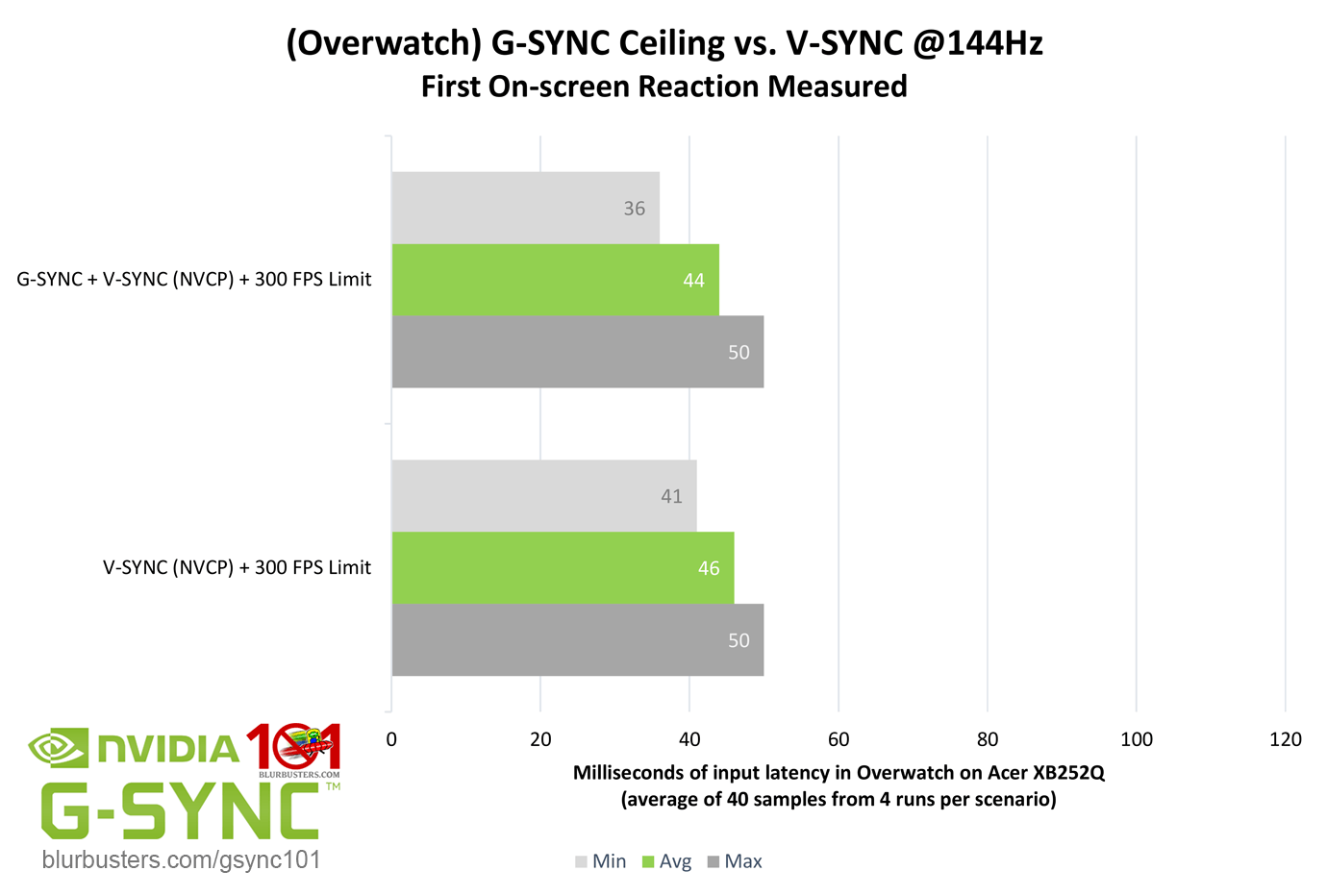
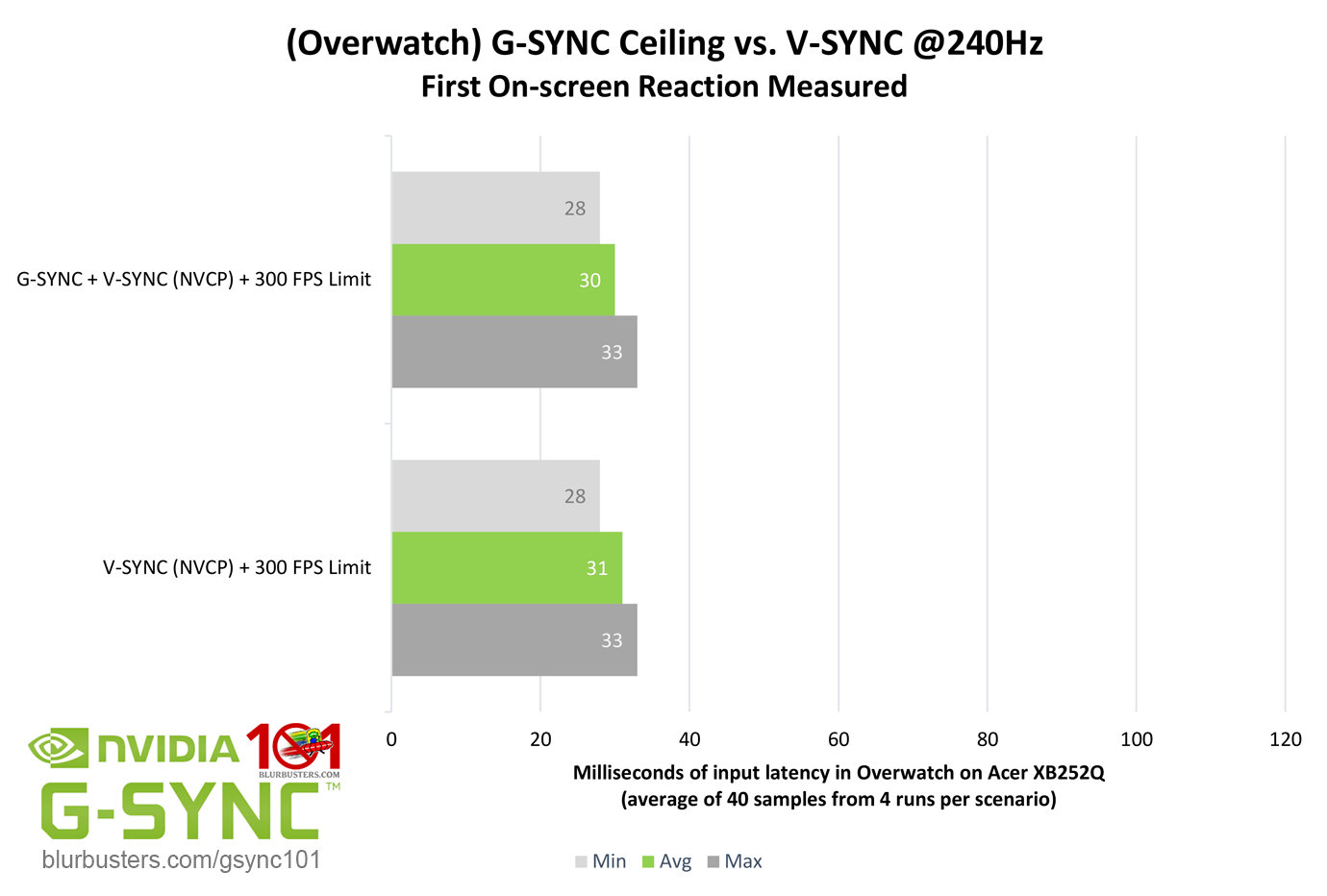
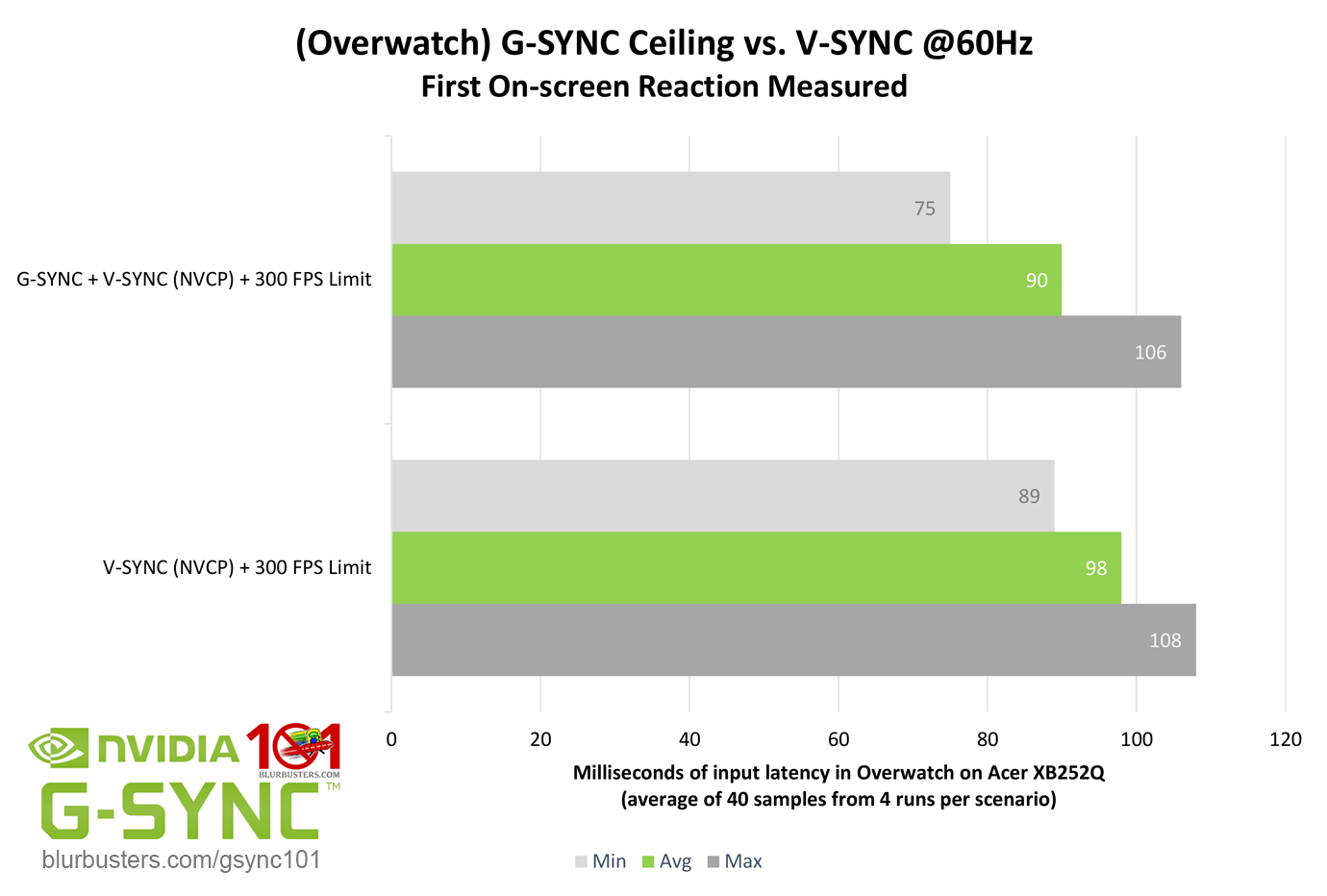
As described in G-SYNC 101: Range, G-SYNC doesn’t actually become double buffer V-SYNC above its range (nor does V-SYNC take over), but instead, G-SYNC mimics V-SYNC behavior when it can no longer adjust the refresh rate to the framerate. So, when G-SYNC hits or exceeds its ceiling, how close is it to behaving like standalone V-SYNC?
Blur Buster's G-SYNC 101: Input Latency & Optimal Settings

Pretty close. However, the G-SYNC numbers do show a reduction, mainly in the minimum and averages across refresh rates. Why? It boils down to how G-SYNC and V-SYNC behavior differ whenever the framerate falls (even for a moment) below the maximum refresh rate. With double buffer V-SYNC, a fixed frame delivery window is missed and the framerate is locked to half the refresh rate by a repeated frame, maintaining extra latency, whereas G-SYNC adjusts the refresh rate to the framerate in the same instance, eliminating latency.

As for “triple buffer” V-SYNC, while the subject won’t be delved into here due to the fact that G-SYNC is based on a double buffer, the name actually encompasses two entirely separate methods; the first should be considered “alt” triple buffer V-SYNC, and is the method featured in the majority of modern games. Unlike double buffer V-SYNC, it prevents the lock to half the refresh rate when the framerate falls below it, but in turn, adds 1 frame of delay over double buffer V-SYNC when the framerate exceeds the refresh rate; if double buffer adds 2-6 frames of delay, for instance, this method would add 3-7 frames.

“True” triple buffer V-SYNC, like “alt,” prevents the lock to half the refresh rate, but unlike “alt,” can actually reduce V-SYNC latency when the framerate exceeds the refresh rate. This “true” method is rarely used, and its availability, in part, can depend on the game engine’s API (OpenGL, DirectX, etc).

A form of this “true” method is implemented by the DWM (Desktop Window Manager) for borderless and windowed mode, and by Fast Sync, both of which will be explained in more detail further on.

Suffice to say, even at its worst, G-SYNC beats V-SYNC.



3853 Comments For “G-SYNC 101”

This site uses Akismet to reduce spam. Learn how your comment data is processed.

Sort by:   newest | oldest | most liked
user2422
Member
user2422

Thanks for the comprehensive guide.

I have some questions on two topics:

1. If i have a 320Hz monitor with G-Sync enabled and play let’s say Apex Legends capped at 240 fps and can’t notice any obvious screen tearing, is there any reason to still use V-Sync in this scenario? From my understanding the latency in this scenario should be roughly the same whether V-Sync is enabled or disabled, so could it potentially have any other up or downsides? Also regarding this question, the increase in smoothness that is often shown with the optimal G-Sync configuration, is that due to the VRR or is it caused by the combination of G-Sync + V-Sync?

2. There seems to be a lot of situational use for some of these settings, so with all your knowledge and own personal experience over all those years now, what are you personally using when it comes to settings like LLM, Reflex, Windows VRR toggle, in-game vs driver V-Sync, what framerate limiters to use and what value to cap to?

Iriodus
Member
Iriodus

So, 2 separate but related questions:

1) For games that use the Vulkan renderer, like Doom Eternal, should we be using borderless fullscreen or exclusive fullscreen?

2) Not sure if you’d know the answer to this one, but since Proton on Linux uses a DirectX-to-Vulkan translation layer, should people use the recommendation for question 1 above, or say if a game is DirectX11 before taking into account the DX-to-Vulkan translation do use Fullscreen/Exclusive Fullscreen as if we were on Windows.

For reference, I’ve replicated the optimal G-Sync setup on my Linux machine, and since switching I’ve just been doing “If it’s originally DX11 or lower? Fullscreen/Exclusive Fullscreen. If it’s originally DX12? I use borderless fullscreen”

ksydew
Member
ksydew

Sorry for posting so much but I have one last question, I just bought the acer Nitro XV275U F5BIIPPRX, it’s a free sync premium Pro monitor but isn’t g sync certified. It should still work with g sync no problem right? I have it turned on same usual settings, g sync indicator is working and on in the top right corner, but just want to make sure it’s fine? It seems like it is but I’m not the expert

ksydew
Member
ksydew

With the newest drivers nvidia has now gotten rid of the nvidia control panel. Does this change anything for how to implement g sync? Has it changed any behavior to your knowledge? I keep g sync on, v sync on and use a frame rate limiter of RTSS. I also use v sync globally. I just had to use DDU due to sudden instability after installing the newest drivers and that’s when I found out nvcp was missing.

Flop
Member
Flop

What’s the best way to go about using both technologies? My main game is CS2, where i use Fixed Refresh. I want to use G-SYNC in pretty much every other game though. It seems that in order to do this, i have to enable G-SYNC in the global settings, then set CS2 to Fixed Refresh in Program settings. I would rather do this the other way around though (though it doesn’t work) since I play CS2 most of the time, and the long alt-tab times are annoying (unless there is a way to fix them) due to the game not using G-SYNC, while the rest of the operating system operates with G-SYNC.

wpDiscuz